

Satrise has recently expanded its range of mushroom growing systems, offering more options for different farm sizes and production goals. This article explains what has changed and how growers can choose a system that actually fits their real-world needs.
Mushroom farming today is very different from what it was even a few years ago. As demand increases and production standards become stricter, growers are under more pressure to deliver consistent results.
In traditional setups, a lot depends on experience. Growers adjust temperature, humidity, and airflow manually, often based on observation. This works to a certain extent, but it also introduces variability. Two growing cycles under slightly different conditions can lead to very different results.
That is why more farms are moving toward controlled systems. With better environmental control, it becomes easier to repeat successful conditions and reduce unexpected fluctuations.
This shift is not about replacing experience. It is about supporting it with systems that make outcomes more predictable.
Until recently, Satrise was mainly known for its container-based mushroom growing systems. These solutions are widely used in commercial farms because they are stable and relatively easy to scale.
However, as more growers entered the industry, it became clear that one type of system could not meet every need. Some farms needed smaller setups to get started, while others wanted more flexibility in how they manage different crops or growth stages.
To address this, Satrise has introduced several new system types alongside its existing container solutions. These include:
Instead of offering a single approach, the product range now covers a broader set of real-world farming scenarios.
One of the biggest challenges in choosing a mushroom growing system is that every farm is different.
A startup may be working with limited space and a small team. Their main goal is to get stable production running without making a large upfront investment.
A commercial farm, on the other hand, is usually focused on efficiency and output. They need systems that can run continuously and scale without disrupting production.
There are also growers who are still experimenting. They might be testing new methods or combining mushroom cultivation with other crops. For them, flexibility is more important than maximum efficiency.
Because of these differences, the “best system” is not the same for everyone. The right choice depends on what you are trying to achieve.
Indoor systems are often the most practical option for growers who are just getting started or working in limited spaces.
They are typically used in environments such as:
These systems are designed to be relatively simple to install and operate. They provide stable growing conditions without requiring large infrastructure.
For many growers, this makes them a good starting point. You can focus on learning the cultivation process and building a consistent workflow.
At the same time, indoor systems do have limitations. As production grows, space can quickly become a constraint. This is something to keep in mind when planning long-term expansion.
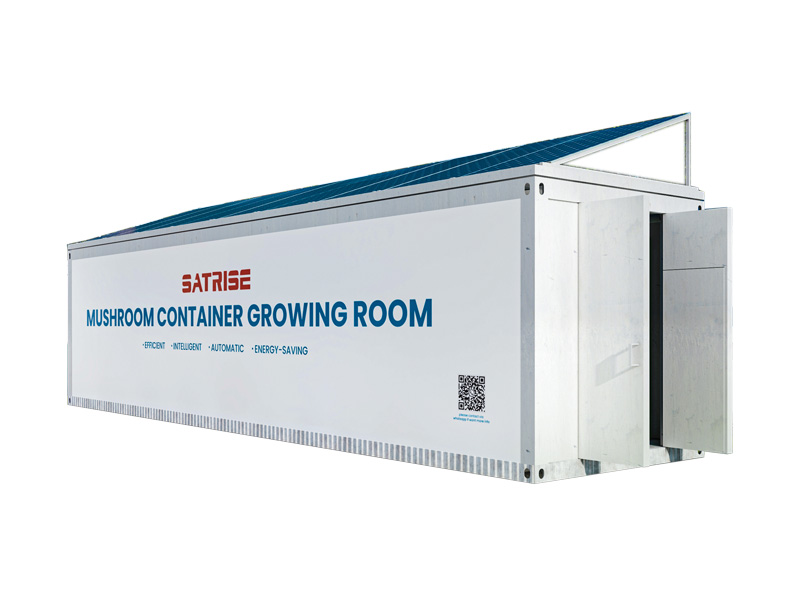
Container systems are still one of the most widely used solutions for commercial mushroom farming.
They provide a controlled environment within a standardized structure, which helps maintain consistency across production cycles. Because each unit operates independently, farms can scale by adding more containers rather than redesigning the entire setup.
The newer container solutions from Satrise also offer more flexibility than before. For example, systems with dual-zone control allow growers to manage different conditions within the same unit. This can be useful when working with multiple growth stages or different varieties.
For farms that are focused on output and expansion, this type of system remains a strong option.
Flexible chambers are designed for situations where adaptability matters more than scale.
These systems are often used in:
Unlike more standardized systems, flexible chambers allow growers to adjust environmental conditions more freely. This makes them suitable for testing and development work.
While they may not deliver the highest production efficiency, they offer something different: the ability to adapt quickly to changing needs.
Looking at real-world use cases can make the differences between systems clearer.
A small urban farm might begin with an indoor system to establish a stable production process. Once demand increases, the same farm may expand using container systems to increase output.
A commercial farm may start directly with container-based solutions because scalability is a priority from the beginning.
In another case, a research facility might rely on flexible chambers to test different environmental conditions and cultivation methods.
These examples show that system choice is closely tied to the stage and direction of the farm.
Before deciding on a system, it helps to think through a few practical questions.
These questions are often more useful than comparing technical specifications alone.
When there are more options available, it becomes easier to make the wrong choice.
One common mistake is focusing too much on price. A cheaper system may seem attractive at first, but it can become limiting if it does not support your long-term plans.
Another mistake is choosing a system that is too advanced for your current operation. More features do not always mean better results, especially if they are not fully used.
It is also easy to underestimate how quickly production needs can grow. Planning ahead can help avoid unnecessary upgrades later.
With the expanded system range, Satrise now offers more flexibility for growers at different stages.
Instead of adapting your operation to fit a single type of system, you can now choose a setup that matches your current situation and adjust as your needs change.
If you want to explore the different system options in more detail, you can find them here:
https://www.satrise.com/products-item/integrated-smart-fruiting-systems/
In the end, the goal is not to choose the most advanced system, but the one that works best for your farm.
Indoor systems are usually the easiest way to start because they are simple and manageable.
They are more common in commercial farming, but can also be used by smaller farms planning to scale.
Yes, many systems are designed to support gradual expansion.
Not necessarily, but basic understanding will help you get better results.
Choosing based only on price without considering long-term needs.
Focus on your space, production goals, and future plans rather than just specifications.
Is one professional company integrating consulting, planning, design, construction, technical services and investment in the mushroom factory.
We has technical department, R&D department, investment department, engineering department, purchasing department, design department, quality control department, finance department and marketing department. It has dozens of OEM production workshops. Satrise’s products include bag filling line, bottle filling line, bed planting production line, sterilization equipment, boiler equipment, purification equipment, liquid spawn production equipment, environmental control equipment and various consumable products.
Over the years, Satrise people have actively explored the international marke and have provided mushroom production line and technical supportsuccessively for more than 100 countries and regions, such as Russia, the United States, Canada, South Korea, France, Germany, Spain, Australia, Malaysia, Thailand, and so on. Its products have been widely recognized by customers.
Please Leave your message you want to know! We will respond to your inquiry within 24 hours!
Product Category