

As shiitake cultivation continues to industrialize, many producers are moving toward higher substrate density to increase output per square meter and improve production efficiency. While the strategy appears straightforward—compress more substrate into each bag—the mechanical and biological implications are far more complex.
High-density production reduces tolerance margins. Substrate structure becomes more sensitive to mechanical input. Small variations that were previously acceptable begin to influence downstream biological behavior. Under these conditions, bagging shifts from a routine filling operation to a precision control step.
Satrise supports mushroom producers across various production stages and scales. In high-density shiitake cultivation specifically, one technical parameter becomes increasingly critical: pressure stability during bagging.
Higher substrate density directly changes the internal physical environment of a shiitake block.
As density increases:
Air channels narrow
Moisture distribution becomes less forgiving
Structural resistance to mycelial growth rises
The substrate must remain compact yet biologically breathable. Achieving this balance requires not only sufficient pressure, but consistent pressure.
When compaction varies between bags, internal structural differences appear:
Slightly tighter core zones
Looser outer regions
Uneven compression gradients
These structural deviations may not be visible externally, but they shape biological performance throughout incubation and fruiting.
In high-density bagging, pressure should not be understood as a single number displayed on a control panel. It is a process consisting of multiple coordinated stages:
Force ramp-up
Compression stabilization
Holding duration
Release control
If any stage fluctuates between cycles, repeatability decreases. Even when peak pressure appears consistent, variations in application speed or holding time can alter internal substrate architecture.
For high-density shiitake blocks, repeatability across thousands of cycles matters more than isolated performance.
Industrial production environments demand continuous operation. A bagging system may process thousands of blocks per shift.
During long runs, mechanical systems experience:
Component heating
Wear accumulation
Power transmission fluctuation
Without stable force control mechanisms, pressure drift occurs gradually. Drift may be small per cycle, but its cumulative effect becomes measurable across batches.
In high-density shiitake production, this gradual inconsistency translates into structural variability between blocks produced at different times of the day.
Structural deviation caused by unstable pressure influences biological development in several ways.
First, oxygen diffusion patterns shift. Over-compressed zones restrict airflow, while under-compressed sections allow excessive moisture migration.
Second, mycelial resistance changes. Mycelium expands according to substrate density. Uneven density leads to uneven colonization speed.
Third, internal stress distribution increases. When compression gradients vary within a block, mechanical stress accumulates during incubation.
These effects combine to produce batch variability that becomes visible only later in the cycle.
Producers working with high-density shiitake substrates often observe certain recurring patterns when pressure stability is insufficient:
Blocks colonize at slightly different speeds
Surface browning timing diverges
First flush synchronization weakens
Yield distribution spreads wider
These differences may not be dramatic individually. However, over multiple production cycles, the operational impact becomes clear.
Labor scheduling becomes more complex. Environmental adjustments require more frequent fine-tuning. Predictability decreases.
The root cause frequently lies in subtle mechanical variation during bagging.
Pressure instability does not always cause early contamination. Instead, it often alters contamination timing.
When internal structure varies:
Moisture pockets may form
Micro-aerobic zones can develop
Localized weakness appears
Contamination may surface mid-cycle rather than immediately after sterilization. Because the delay separates cause and effect, troubleshooting becomes more difficult.
Stabilizing bagging pressure reduces hidden structural inconsistencies that contribute to these delayed risks.
Many production decisions prioritize throughput. Higher hourly capacity is often seen as a primary metric when selecting bagging equipment.
However, in high-density cultivation, throughput must be balanced with stability.
A system optimized purely for speed may introduce:
Abrupt force application
Inconsistent compression profiles
Increased mechanical rebound
Under lower density conditions, such variation may be acceptable. Under high-density targets, it can compromise structural uniformity.
Producers at advanced stages of development increasingly recognize that controlled consistency yields better long-term efficiency than maximum short-term output.
Effective high-density bagging depends on precise mechanical control.
Key aspects include:
Stable force transmission
Minimal mechanical backlash
Controlled energy transfer
Predictable cycle repetition
Mechanical backlash or inconsistent linkage response can introduce subtle pressure fluctuation even when nominal settings remain unchanged.
Maintaining tight mechanical tolerance helps preserve compaction repeatability.
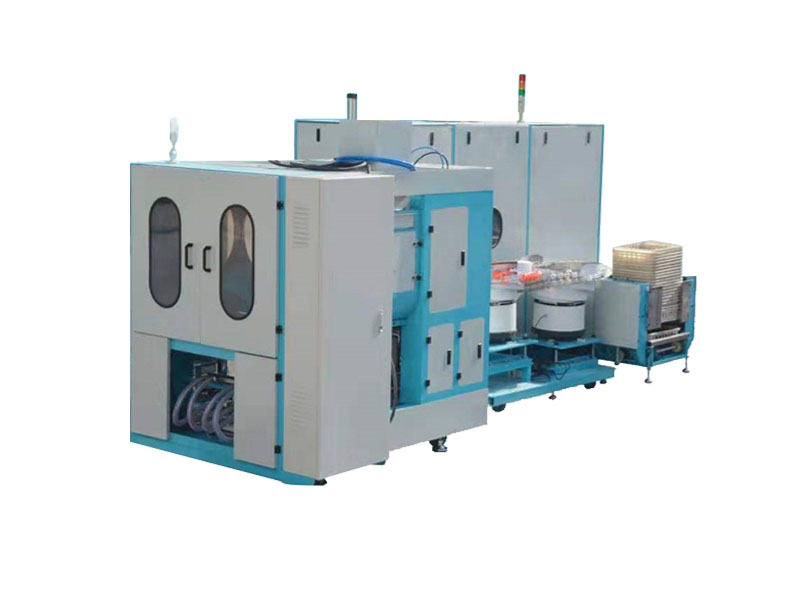
Satrise bagging machines are developed to support diverse mushroom production needs, from early-stage operations to industrial-scale cultivation.
Within this broad product range, configurations intended for high-density shiitake production emphasize pressure stability as a core design priority.
Application-focused engineering includes:
Reinforced structural frames to reduce flex
Controlled drive systems for smooth compression
Stable transmission pathways for consistent force output
This approach aligns mechanical design with biological requirements under high-density operating conditions.
In high-density bagging, force transmission quality determines how accurately pressure reaches the substrate.
Stable transmission ensures:
Reduced energy loss
Consistent compression response
Limited cycle variation
If force transmission fluctuates due to mechanical slack or component drift, internal block structure will vary accordingly.
Maintaining transmission integrity under continuous load is therefore essential for uniform block production.
The holding phase during compression allows substrate particles to settle and stabilize.
If holding duration varies:
Compaction density may differ
Internal stress distribution changes
Moisture movement shifts
Controlled holding time improves structural consistency across blocks.
In high-density production, even small deviations in holding behavior influence downstream colonization rhythm.
Release behavior also affects substrate structure.
Abrupt release can cause:
Micro-fractures inside the substrate
Uneven rebound
Density redistribution
Controlled release minimizes internal disturbance and preserves compaction uniformity.
Attention to release precision supports stable block architecture.
Short demonstration tests rarely expose pressure instability.
True evaluation requires observing:
Extended operating hours
Continuous production cycles
Variable environmental conditions
Mechanical systems that maintain consistent behavior over long durations provide stronger assurance of repeatable results.
High-density shiitake production demands this level of long-run reliability.
When pressure stability is achieved, operational advantages extend beyond the bagging stage.
Uniform blocks contribute to:
Consistent incubation speed
Predictable browning development
More synchronized flush cycles
Reduced variation in harvest size
These improvements simplify management decisions and enhance overall production control.
Pressure stability supports efficiency in indirect ways.
Producers may experience:
Lower corrective labor requirements
Reduced need for environmental adjustments
Improved room scheduling predictability
Decreased stress on supervisory staff
Consistency reduces reactive management and strengthens planning confidence.
Over time, stability contributes to smoother scaling and more sustainable expansion.
Producers typically begin evaluating pressure stability more seriously when they observe:
Increasing density targets
Expansion of production capacity
Rising demand for batch standardization
At this stage, bagging equipment becomes part of a broader process optimization strategy.
Rather than focusing solely on speed or cost, decision-making shifts toward structural repeatability and long-term consistency.
Satrise supports mushroom producers at different strategic stages. Equipment selection should align with production goals.
For operations prioritizing:
High-density substrates
Yield predictability
Scalable batch control
pressure stability becomes a central evaluation factor.
Understanding how mechanical consistency shapes biological outcomes helps producers make informed upgrade decisions.
In high-density shiitake cultivation, bagging is not merely a filling task. It defines the physical architecture of every block entering incubation.
Pressure stability during this step directly influences structural integrity, biological uniformity, contamination timing, and operational predictability.
As mushroom production systems become more refined and data-driven, mechanical repeatability becomes inseparable from biological performance.
For producers advancing toward higher density and greater consistency, evaluating bagging pressure stability is a practical step toward long-term operational reliability.
Is one professional company integrating consulting, planning, design, construction, technical services and investment in the mushroom factory.
We has technical department, R&D department, investment department, engineering department, purchasing department, design department, quality control department, finance department and marketing department. It has dozens of OEM production workshops. Satrise’s products include bag filling line, bottle filling line, bed planting production line, sterilization equipment, boiler equipment, purification equipment, liquid spawn production equipment, environmental control equipment and various consumable products.
Over the years, Satrise people have actively explored the international marke and have provided mushroom production line and technical supportsuccessively for more than 100 countries and regions, such as Russia, the United States, Canada, South Korea, France, Germany, Spain, Australia, Malaysia, Thailand, and so on. Its products have been widely recognized by customers.
Please Leave your message you want to know! We will respond to your inquiry within 24 hours!
Product Category