

In the global mushroom cultivation industry, production models vary widely depending on labor conditions, investment capacity, and farm scale. While fully automated production lines continue to serve large industrial operations, many bag-cultivated mushroom farms operate under very different constraints.
For these producers, substrate bagging is often limited not by technology itself, but by labor availability, operating cost, and return on investment. Manual bagging depends heavily on stable labor input, while fully automatic bagging lines frequently exceed actual production needs.
As a result, there is growing interest in modular and semi-automatic bagging equipment that focuses on practical labor reduction without introducing unnecessary cost or complexity.
Fully automatic mushroom substrate bagging lines are designed for continuous, high-volume production. However, farms producing several hundred bags per hour often encounter challenges such as:
Initial investment that outweighs actual production demand
Automation capacity that remains partially unused
Increased operational and maintenance complexity
Limited flexibility when production plans change
In these cases, the core issue is not insufficient automation, but automation that is mismatched to real operating conditions.
Rather than viewing substrate bagging as a single machine function, more producers are beginning to treat it as a series of connected production steps, each with different labor and efficiency characteristics.
A typical bagging workflow includes:
Substrate filling and compaction
Empty bag loading
Bag mouth processing
Handling of finished bags
By targeting the most labor-intensive steps, farms can improve overall efficiency without fully automating the entire process.
The bagging machine is selected based on:
Bag-cultivated mushroom species such as oyster, shiitake, and king oyster mushrooms
Substrate formulation and moisture content
Bag size and density requirements
Target hourly production capacity
The focus is on stable filling and consistent bag quality, rather than maximum output speed.
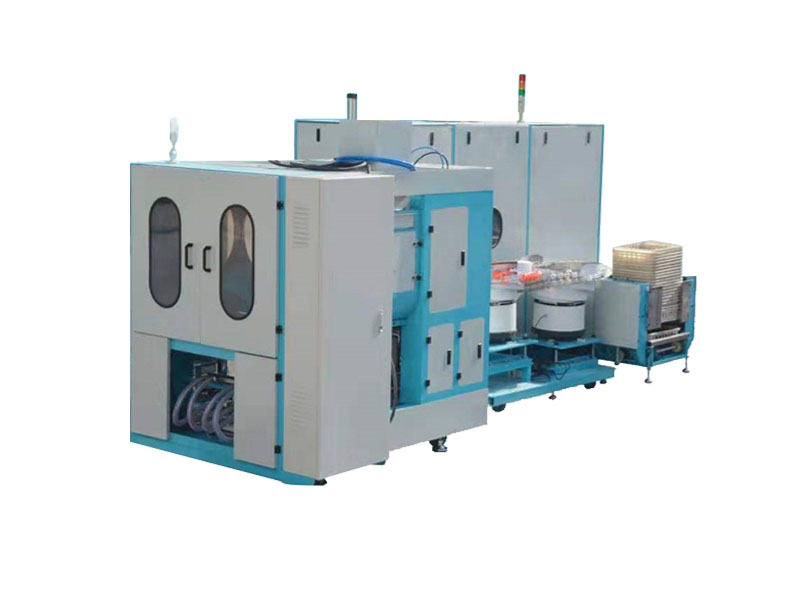
Manually placing empty plastic bags onto the machine sleeve is one of the most repetitive tasks in bag cultivation.
An automatic bag loading unit:
Loads empty bags onto the sleeve automatically
Operates in sync with the bagging machine
Reduces operator workload
Improves production rhythm
This unit often provides a noticeable labor-saving effect with a relatively controlled investment.
After filling, different bag-cultivated mushroom operations apply different bag mouth treatments depending on inoculation methods.
Common post-bagging equipment includes:
Bag tying or sealing machines
Hole-forming and stick-inserting machines
These units are positioned directly after the bagging stage to minimize unnecessary handling.
For farms aiming to further reduce labor input, finished substrate bags can be transferred into baskets or racks using handling equipment.
This step:
Reduces repetitive lifting
Improves workplace ergonomics
Can be added later as production volume increases
This modular bagging approach is designed exclusively for bag-cultivated mushroom production and is suitable for:
Oyster mushrooms
Shiitake mushrooms
King oyster mushrooms
Other commercial bag-grown varieties
It is not suitable for bottle cultivation systems, such as those used for enoki mushrooms, which require a different production process and equipment layout.
Leveraging its flexible and practical design, this modular bagging approach has been applied across a variety of international markets and operating environments. The configuration principle is particularly suitable for regions where labor resources are limited, production scale remains moderate, and gradual automation is preferred over full-scale automation.
In practice, this concept has demonstrated strong adaptability in different agricultural contexts, ranging from Austria in Europe, to Israel in the Middle East, and to multiple Asian markets including India, the Philippines, and Brunei. Despite differences in labor cost, production habits, and farm size, the same modular logic can be adjusted to meet local requirements.
By allowing farms to select and combine equipment based on actual production conditions, the modular structure ensures that investment remains aligned with real operational needs. This approach helps producers avoid the cost and rigidity associated with oversized, fully automated bagging systems, while still achieving meaningful improvements in labor efficiency and production stability.
Across the mushroom cultivation sector, producers are increasingly shifting away from maximum automation toward practical automation. Equipment solutions that emphasize real labor-saving results, flexible configuration, and controlled investment are gaining attention, particularly among bag-cultivated mushroom farms operating at small to medium scale.
This focused approach to practical automation delivers measurable efficiency improvements while maintaining cost control. Preliminary application data indicate that by introducing only key modules—such as the Automatic Bag Loading Unit—the repetitive labor time required for the bagging process can be reduced by approximately 30% to 50%.
At the same time, by avoiding unnecessary system integration and excess capacity, a farm’s initial investment is often limited to 40% to 60% of the cost of a fully automatic production line, while still achieving around 80% of the core labor-saving objectives. This allows small-to-medium scale farms to recover their automation investment more quickly while preserving capital flexibility.
For bag-cultivated mushroom farms operating at small to medium scale, substrate bagging equipment must balance efficiency, labor reduction, and investment control.
A modular bagging approach enables producers to:
Reduce labor dependence
Maintain stable and consistent production
Avoid unnecessary automation costs
As labor markets and production requirements continue to evolve, such practical and flexible equipment configurations are becoming an increasingly relevant option for bag-cultivated mushroom production.
Is one professional company integrating consulting, planning, design, construction, technical services and investment in the mushroom factory.
We has technical department, R&D department, investment department, engineering department, purchasing department, design department, quality control department, finance department and marketing department. It has dozens of OEM production workshops. Satrise’s products include bag filling line, bottle filling line, bed planting production line, sterilization equipment, boiler equipment, purification equipment, liquid spawn production equipment, environmental control equipment and various consumable products.
Over the years, Satrise people have actively explored the international marke and have provided mushroom production line and technical supportsuccessively for more than 100 countries and regions, such as Russia, the United States, Canada, South Korea, France, Germany, Spain, Australia, Malaysia, Thailand, and so on. Its products have been widely recognized by customers.
Please Leave your message you want to know! We will respond to your inquiry within 24 hours!
Product Category